
World Cup 2026 Tech: The Smart Ball, AI Referees and the Data Changing Football Foreve



The Tech Inside World Cup 2026: The Smart Ball, AI Referees and the Data Running the Biggest Tournament Ever
48 teams. 104 matches. Three countries. The 2026 FIFA World Cup is the biggest football tournament ever put together, and underneath all the flags and goals, there is a layer of technology running through it that most fans have barely heard about. This is not just about faster VAR decisions or prettier broadcast graphics. The infrastructure beneath this tournament has changed fundamentally, and it starts with the ball itself.
Most of the conversation around the 2026 World Cup is about squads, fixtures, and who might lift the trophy in New York on July 19. Fair enough. You can check the full match schedule and all 48 teams and groups on Footgoal. But if you want to understand why this tournament feels different to watch, why decisions are faster, why officiating looks sharper, and why the data coming out of every match is richer than anything seen before — you need to look at what is actually inside the pitch, inside the ball, and inside the systems running behind the cameras.
The Trionda: A Football With a Chip Inside
Start with the ball. Adidas unveiled the official 2026 match ball, called the Trionda, in October 2025. The name blends the Spanish words for "three" and "wave" — a nod to the three host nations, the United States, Canada, and Mexico. The design uses red, blue, and green in swirling patterns across a four-panel construction, with each country given its own symbol: a star for the USA, a maple leaf for Canada, an eagle for Mexico.
All of that is surface. What matters is inside the ball.
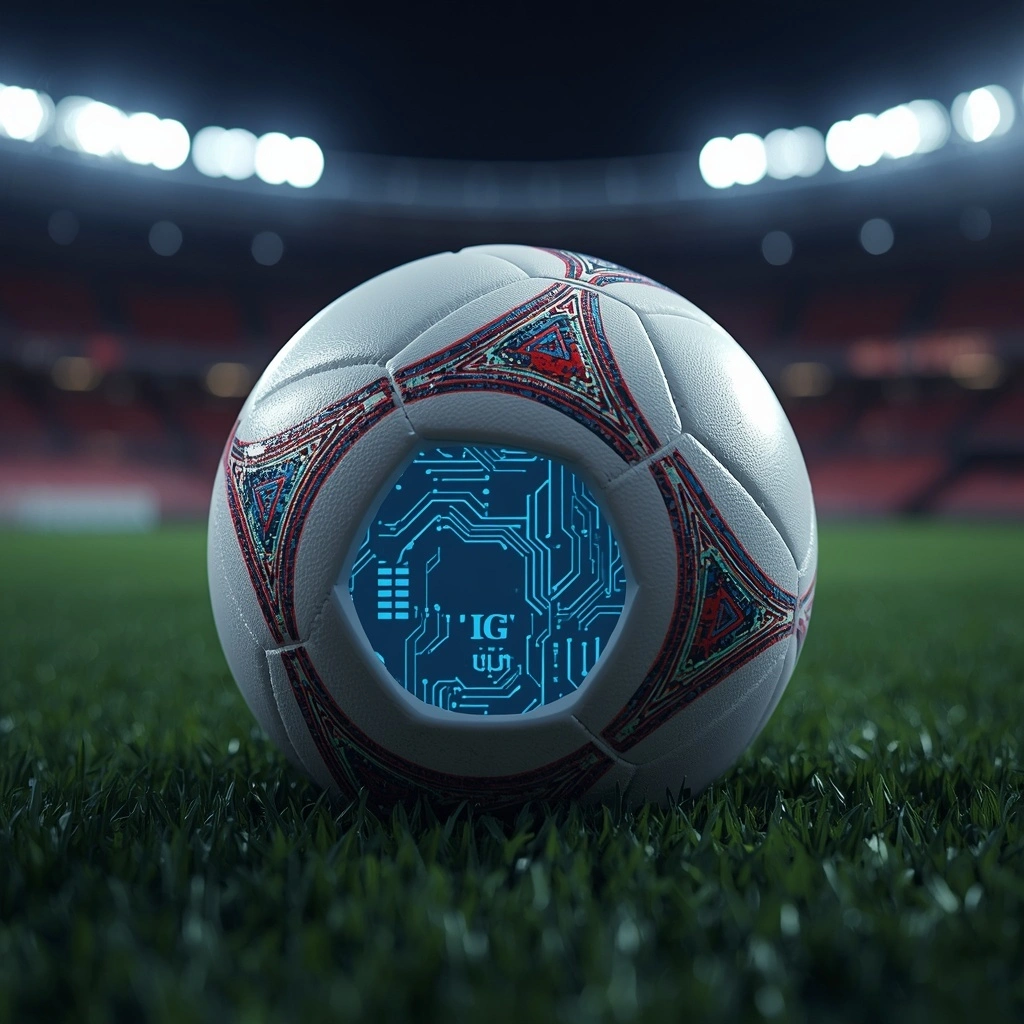
The Trionda carries what Adidas calls Connected Ball Technology — a 500Hz inertial measurement unit (IMU) motion sensor chip that tracks the ball's exact position and movement 500 times per second. That chip has been repositioned since the 2022 World Cup version. Instead of being mounted at the centre of the ball via a suspension system, it now sits inside a specially created layer in one of the four panels, with counterweights placed in the three other panels to keep the ball balanced in flight.
That sounds like a minor engineering tweak. It is not. The previous centre-mounted system had limits when the ball was under heavy spin or deflection. The side-mounted approach, developed in partnership with Kinexon, allows for more consistent data even during the erratic movements that happen in a penalty box scramble or a long-range effort with heavy swerve.
The chip transmits real-time data to the VAR system. When combined with player position tracking and AI processing, the system helps officials make faster and more accurate offside decisions. It can also help identify individual touches during potential handball incidents — something that was essentially impossible to verify precisely before sensor technology entered the ball.
"Tracking the ball itself was always the hardest. Things like touch frequency during a dribble were impossible to measure without a sensor inside."
— Hannes Schaefke, Football Innovation Lead, AdidasFor fans who have sat through tedious VAR stoppages over inconclusive handball replays, the implication is real. The ball knows what happened. And it can prove it in seconds.
Lenovo and FIFA: Football AI Pro
In January 2026, FIFA President Gianni Infantino and Lenovo Chairman Yuanqing Yang stood together at the Sphere in Las Vegas and unveiled what they called "Football AI" — a group of technologies designed to change how the tournament is officiated, analysed, and experienced.
The centrepiece is Football AI Pro, a generative AI knowledge assistant built specifically for the 48 teams competing at the 2026 World Cup. The idea behind it is more interesting than it might first sound. At the top level of international football, access to advanced data analysis has always favoured the wealthiest federations. Spain, Germany, Brazil, France — these are teams with full analytics departments, dedicated data scientists, and years of infrastructure. A smaller federation making its first World Cup might have a good squad and almost nothing in the way of post-match analysis tools.
Football AI Pro changes that. All 48 teams get access to the same AI-powered analytical capabilities — pre-match planning and post-match review built on FIFA's Football Language model, which processes hundreds of millions of football data points. Coaches can query it in multiple languages and get back insights in text, video clips, graphs, and 3D visualisations. For a team with limited resources, that kind of analysis was previously out of reach entirely.
It cannot be used during live play. But before a match and after one, it gives every coach in the tournament access to a level of insight that was previously reserved for the sport's most well-funded operations.
3D Player Avatars and Offside Calls That Actually Make Sense
One of the most consistently frustrating parts of the VAR era has been the offside check. A freeze frame. A line drawn across a frozen image. An armpit declared offside by a margin nobody can actually see with the naked eye. The graphic has never matched the speed or clarity that the moment deserved.
For 2026, FIFA and Lenovo have introduced AI-enabled 3D player avatars. Every player at the tournament was digitally scanned — a process that takes approximately one second per player and captures precise body-part dimensions. Those scans create a 3D model for each individual that the tracking system can use to follow players reliably even during fast movement or when their body is partially obscured by another player.
During an offside check, instead of a flat freeze frame, the VAR system now uses those 3D models to display the decision in a more realistic and readable way. The key point is not just visual — the 3D tracking is more accurate. A limb that appears ambiguous in a 2D camera angle becomes much clearer when the system already has a precise skeletal model of the player in question.
The technology was tested at the 2025 FIFA Intercontinental Cup, scanning players from CR Flamengo and Pyramids FC and running the system throughout the match. It worked. It is now standard across all 16 World Cup venues.
Referee View: Watching Football From Inside the Game
The other piece of the Lenovo and FIFA package is an upgraded version of Referee View — a broadcast feed from a camera attached to the referee's kit, showing exactly what the official on the pitch is seeing in real time.
The original version of Referee View was trialled at the 2025 FIFA Club World Cup. The footage was there, but the movement of a referee running at full speed, turning quickly, and constantly changing direction made the picture hard to follow — motion blur, shaky frames, disorienting cuts.
The 2026 version uses AI-powered stabilisation software to smooth the footage in real time. The result is a first-person perspective from inside the match that is actually watchable. It is a different kind of access — closer to how a central midfielder experiences the game than anything broadcast has offered before. For a fan watching a tight decision around a penalty area, seeing it through the referee's eyes is genuinely new ground.
The Stadiums and the Data Layer Underneath Them
Beyond the ball and the officials, the stadiums themselves are running a level of infrastructure that most fans walking through the turnstiles will never think about.
The semi-automated offside system uses 12 dedicated tracking cameras per stadium, all feeding positional data into a central AI system that processes the information and delivers a decision in milliseconds. Player tracking across the pitch generates data at 25 frames per second. Wearable sensors used in training — embedded in vests — monitor heart rate, sprint load, and muscle fatigue in real time, though those systems are training-side rather than match-side.
Some of the stadiums were already running commercial IoT infrastructure before FIFA arrived. Sensor networks monitoring crowd movement, structural loads, and energy use were already in place. The World Cup tournament systems have essentially been layered on top of smart-building infrastructure that was originally built for something else entirely.
| Technology | What it does | Who provides it |
|---|---|---|
| Connected Ball Technology (Trionda) | 500Hz sensor tracks ball position and touch data in real time | Adidas + Kinexon |
| Football AI Pro | Generative AI analysis tool for all 48 competing teams | FIFA + Lenovo |
| 3D Player Avatars | Full-body digital scans for accurate offside tracking and broadcast display | FIFA + Lenovo |
| Referee View (AI-stabilised) | Real-time first-person broadcast from the referee's camera | FIFA + Lenovo |
| Semi-automated offside system | 12 tracking cameras per stadium, AI decision in milliseconds | FIFA |
| Stadium IoT networks | Crowd flow, structural, and energy monitoring across all venues | Venue operators + Verizon |
What This Actually Means For the People Watching
Technology in football tends to get discussed in two ways. Either it is celebrated as progress, or it is blamed for killing the emotion — the long VAR pauses, the disallowed celebrations, the clinical precision applied to moments that used to belong to the crowd.
The honest answer is that the 2026 technology is trying to fix the second problem without losing the first. Faster decisions. Cleaner graphics. Systems that explain themselves better to the people sitting in the stands and watching at home. The Trionda's sensor does not add bureaucracy to the game — it removes the ambiguity that made bureaucracy necessary. The 3D avatar offside check is not designed to slow things down. It is designed to make the explanation visible and readable in the seconds after a decision is made.
There will still be arguments. That is football. But fewer of those arguments should hinge on a blurry freeze frame or a referee who could not physically see what happened from where they were standing.
For anyone heading to one of the 16 stadiums across North America this summer — check the Footgoal stadium guide for access details, transport, and what to bring, and the full match schedule to plan which games you want to catch — the experience on the pitch is going to be different. Not noisier, not louder, not more spectacular in the ways that matter most. But more accurate, more transparent, and more connected to the data running beneath every touch, every sprint, and every ball that crosses the line.
That is the World Cup 2026. The football is still football. It is just better equipped than ever before.
Sources & Further Reading
.webp)