
Can Fans Attend Two World Cup 2026 Matches in One Day?



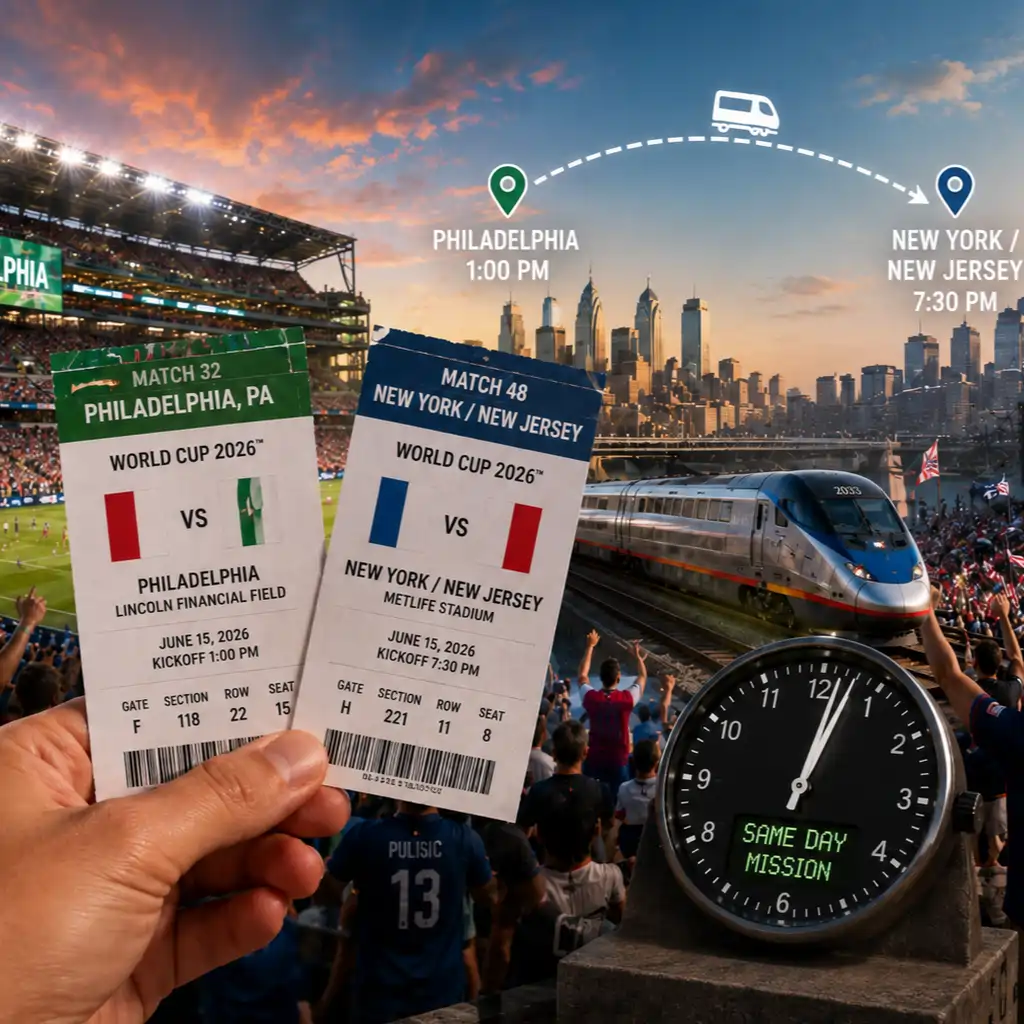
Yes, but only for a handful of routes. For most fans, attending two World Cup 2026 matches in one day will be less of a clever travel hack and more of a gamble with traffic, airports, stadium queues, and kickoff times.
That is the key difference with this tournament. World Cup 2026 is not a compact event where fans can move between stadiums by metro. It is spread across 16 host cities in the United States, Canada, and Mexico, with 104 matches across the biggest World Cup schedule ever. The U.S. alone will host most of the tournament, while Mexico and Canada also have major fixtures, including opening matches in Mexico City and Toronto.
So the real question is not whether fans can attend two World Cup matches in one day. The better question is: which routes are actually realistic?
The Two-Match Dream Sounds Easier Than It Is
On paper, some World Cup 2026 host cities look close enough to combine. New York/New Jersey and Philadelphia. Dallas and Houston. Seattle and Vancouver. Los Angeles and the San Francisco Bay Area. But a two-hour flight is not a two-hour transfer.
But a two-hour flight is not a two-hour transfer. A fan still has to move through the full matchday chain before even thinking about the second kickoff.
That chain breaks very easily. One traffic jam outside MetLife Stadium, one TSA delay, one missed train, or one late kickoff can ruin the whole plan.
The stadium locations matter too. MetLife Stadium is in East Rutherford, not Manhattan. AT&T Stadium is in Arlington, not downtown Dallas. Levi’s Stadium is in Santa Clara, not central San Francisco. SoFi Stadium is in Inglewood, not central Los Angeles. These are NFL-sized venues built for huge crowds, parking lots, and long event-day traffic patterns. That makes World Cup 2026 travel very different from simply moving between two city centers.
This is why same-day World Cup travel only makes sense when the cities are close, the match schedule gives fans a large buffer, and the route avoids airports or international borders whenever possible.
The Best Route Is New York/New Jersey and Philadelphia
If one city pair can make this idea work, it is New York/New Jersey and Philadelphia. The route connects MetLife Stadium in East Rutherford with Lincoln Financial Field in Philadelphia. Both venues are in the Eastern Time Zone, both sit in the same broader travel corridor, and fans have more practical ground transport options than in most other World Cup 2026 city combinations.
This is the strongest same-day scenario:
A fan watches an early match at Lincoln Financial Field, leaves quickly after full-time, travels north, and reaches MetLife Stadium for an evening match. The opposite direction can also work, but leaving MetLife after a major World Cup fixture could be slower because the stadium is outside New York City and event-day transport around East Rutherford can get messy.
Still, even this “best” route needs a real buffer. Fans should not treat it like a casual day trip. If the first match starts in the afternoon and the second starts in the evening, the plan becomes tight very quickly. If both matches are in the group stage and the kickoff gap is wide, it becomes much more realistic.
Dallas and Houston Are Possible, But Not Comfortable
Dallas and Houston will tempt a lot of fans because both are in Texas. That does not make the route easy.
Dallas Stadium, better known as AT&T Stadium, is in Arlington. Houston Stadium, better known as NRG Stadium, is in Houston. U.S. Soccer lists Dallas Stadium as a venue with five group-stage matches, two Round of 32 matches, one Round of 16 match, and one semifinal. Houston Stadium will host five group-stage matches, one Round of 32 match, and one Round of 16 match.
That creates plenty of potential overlap for fans planning a Texas World Cup trip. But doing Dallas and Houston on the same day is still risky.
Driving is long and tiring, especially around matchday crowds. Flying can be faster, but it adds airport transfers, security lines, boarding time, and the risk of delays. The route only makes sense if the first match is early, the second match is late, and the fan is prepared to move immediately after the final whistle.
This is not the kind of plan where you stay for post-match photos, grab food, walk slowly to the parking lot, and then figure things out. Dallas to Houston can work only if the whole day is built around movement.
For most fans, Dallas and Houston are better as a two-day World Cup route. Watch one match, travel overnight or the next morning, then enjoy the second city properly.
Seattle and Vancouver Look Close Until the Border Gets Involved
Seattle and Vancouver are one of the most interesting World Cup 2026 travel pairs. Lumen Field and BC Place are both strong fan venues, and the Pacific Northwest makes sense as a regional trip. But for two live stadium matches in one day, the border is the problem.
Seattle Stadium, known as Lumen Field, will host group-stage matches, a Round of 32 match, and a Round of 16 match. Vancouver’s BC Place will also host group-stage matches and knockout fixtures. On a normal travel itinerary, that is a great pairing. For same-day stadium hopping, it is fragile.
Fans would need to deal with either a cross-border drive, a flight, or another route that still depends on border control and timing. Even if the distance feels manageable, the uncertainty is too high. One long border queue can wipe out the buffer before the second match.
Seattle and Vancouver should absolutely be part of a smart World Cup 2026 fan route. Just not as a same-day two-stadium plan unless the schedule is extremely generous.
Los Angeles and the Bay Area Are Not as Simple as the Flight Time
Los Angeles and the San Francisco Bay Area look like another tempting combination. There are frequent flights between Southern California and Northern California, and both regions are major World Cup 2026 host areas. But again, the problem is not just the flight.
Los Angeles Stadium is SoFi Stadium in Inglewood. San Francisco Bay Area Stadium is Levi’s Stadium in Santa Clara. So the real route is not “LA to San Francisco.” It is stadium to airport to flight to airport to Santa Clara, with security and matchday traffic on both ends.
U.S. Soccer notes that SoFi Stadium will host the USMNT’s opening World Cup match on June 12, along with group-stage matches, Round of 32 matches, and a quarterfinal. Levi’s Stadium will host five group-stage matches and one Round of 32 match.
That gives fans plenty of reasons to visit both areas. But trying to force both into one day is only realistic with perfect kickoff times. Even then, it is stressful. A fan could spend more time moving through airports and stadium traffic than actually enjoying the World Cup.
This route works much better as a California World Cup trip across two or three days.
Some Routes Are Just Bad Ideas
A few same-day combinations should be treated as no-go routes from the start. Miami to Seattle is not a bold fan adventure. It is a continent-sized headache. Vancouver to Mexico City adds distance, international travel, and border complexity. Los Angeles to Toronto looks possible only if someone stares at flight times and ignores everything before and after the flight. Mexico City to New York/New Jersey is too much for one matchday unless the goal is stress.
The same goes for Kansas City to Miami or Boston to Dallas. Could someone technically build a route with flights? Maybe. Should a normal fan spend hundreds or thousands of dollars on tickets while depending on that plan? Probably not.
This is where the article needs to be honest. World Cup 2026 is spread across North America. The scale is part of the spectacle, but it also kills many same-day travel fantasies.
A simple rule works well: if the plan needs everything to go perfectly, it is not a realistic plan.
Group Stage Matches Are Much Safer Than Knockout Games
Fans trying to attend two World Cup 2026 matches in one day should focus on the group stage.
Group-stage matches can still have long stoppage time, but they do not go to extra time or penalties. That makes the end time more predictable. Once the knockout rounds begin, the whole plan becomes unstable. A Round of 32 or Round of 16 match can run long. A quarterfinal or semifinal can turn into a marathon. And nobody should combine the World Cup final at MetLife Stadium with another live stadium match on the same day.
MetLife Stadium will host the 2026 World Cup final, along with group-stage and knockout matches, making it one of the central venues of the tournament. That final should be treated as a full-day event, not one stop in a travel challenge.
The best two-match plan would involve two group-stage fixtures, a large kickoff gap, one time zone, and a short ground route. Anything beyond that starts to become much less reliable.
Can Fans Watch Two Matches in the Same City?
For two live stadium matches, usually no. World Cup 2026 host cities are built around one main tournament stadium per city or metro area. That means fans should not expect a scenario where they watch one match at noon and another at a different stadium across town in the evening.
But there is a smarter version of the idea: watch one match at the stadium and another at a fan zone, bar, or public viewing event.
That may actually be the best experience for many fans. For example, someone could attend a match at SoFi Stadium and then watch another game at a Los Angeles fan event. A fan in New York/New Jersey could go to MetLife Stadium and watch a later match in the city. In Mexico City, a match at Estadio Banorte, still widely known by many fans as Estadio Azteca, could be paired with a public viewing or bar atmosphere later in the day.
This version gives fans a full World Cup day without turning the tournament into an airport sprint.
What Fans Should Check Before Buying Two Same-Day Tickets
Before buying tickets for two World Cup matches on the same day, fans should ask a few practical questions.
The hardest question is also the most important: can you afford to miss the start of the second match?
If the answer is no, the plan is probably too tight.
World Cup tickets are expensive. Travel will be expensive. Hotels in host cities will be expensive. Building the whole day around a fragile connection is a risky way to experience the tournament.
The Smarter Strategy Is City Clustering
Most fans who want to see more football should not aim for two stadium matches in one day. They should aim for smart city clusters.
New York/New Jersey and Philadelphia make the most sense for fans who want the closest thing to a same-day double. Add Boston, and it becomes a strong East Coast route across multiple days.
Dallas and Houston can work as a Texas-focused trip, especially if fans build in travel time instead of rushing between kickoffs. Los Angeles and the Bay Area make sense as a California route, not a one-day sprint. Seattle and Vancouver are a strong Pacific Northwest pairing, but the border makes them better across two days. Mexico City, Guadalajara, and Monterrey can also form a strong Mexico route, but that should be planned as its own trip rather than mixed casually with U.S. stadiums.
That is the better way to approach World Cup 2026 travel: fewer panic transfers, more actual football, and more time to enjoy the host cities.
Final Verdict: Can Fans Attend Two World Cup 2026 Matches in One Day?
Fans can realistically attend two World Cup 2026 matches in one day, but only in limited cases.
The best option is New York/New Jersey and Philadelphia. Dallas and Houston are possible but uncomfortable. Los Angeles and the Bay Area work better as a multi-day trip. Seattle and Vancouver are attractive, but the border makes same-day planning risky. Long-distance routes like Miami to Seattle, Vancouver to Mexico City, or Los Angeles to Toronto should be avoided.
For most fans, the better plan is simple: attend one match at the stadium, then watch another game at a fan zone or bar in the same host city.
Two live matches in one day is possible. But in World Cup 2026 travel, possible and realistic are not the same thing.
FAQ
Can fans attend two World Cup 2026 matches in one day?
Yes, but only with the right route and a large gap between kickoffs. New York/New Jersey and Philadelphia is the most realistic city pair. Routes involving long flights, border crossings, or different time zones are much harder.
What is the easiest World Cup 2026 city pair for two matches in one day?
New York/New Jersey and Philadelphia is the easiest same-day pair because the cities are relatively close, share the same time zone, and have more realistic ground transport options than most other host city combinations.
Is a short flight enough time between two World Cup matches?
Not by itself. A short flight can still turn into a long transfer once fans include stadium exit time, airport security, boarding, delays, arrival transport, and entry at the second stadium.
Is it easier to attend two matches during the group stage?
Yes. Group-stage matches are safer for same-day planning because they cannot go to extra time or penalties. Knockout-stage matches are harder to combine because they can run much longer.
Can fans watch two World Cup matches in the same host city?
Usually not as two live stadium matches. Each host city has one main World Cup venue. A better plan is to watch one match at the stadium and another at a fan zone, sports bar, or public viewing event.
Which World Cup 2026 routes should fans avoid for same-day matches?
Fans should avoid routes like Miami to Seattle, Vancouver to Mexico City, Los Angeles to Toronto, Mexico City to New York/New Jersey, Kansas City to Miami, and Boston to Dallas. These routes involve too much distance, too much transfer risk, or international travel complications.
Comments
Leave a Comment
Comments
What people are saying
Leave a Comment
Comments are reviewed before they appear.
Comments
.webp)